Forearm Pain Symptoms
The most common symptoms of Forearm Pain include weakness and pain, usually when you are gripping something.
True Forearm Pain symptoms will be primarily muscular and will be felt in the muscles between the wrist and the elbow. Forearm symptoms almost always include grabbing, aching, weakness, and/or possibly throbbing. You might even get some stabbing pain if you are straining your forearm muscles to their limit.
Forearm Pain does not usually affect any of the nerves that pass through the forearms, so if you are experiencing any numbness or tingling in your forearms or hands, then it is a good idea to check out the Carpal Tunnel or Thoracic Outlet sections of this website to see if your symptoms match either of those conditions.
Your Forearm Pain symptoms are almost entirely caused by how you use your hands and arms now, and how you have used them in the past. Symptoms can also be caused by previous injury to your forearms as well.
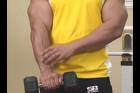
Forearm Pain Symptoms Near The Elbow
Near the elbow (just below it, actually), there are muscles referred to as the forearm rotators. They literally do as advertised, by rotating the forearms from palm-down to palm-up, and vice versa. When you feel pain in this area, it's this proximity to the elbows that can create some confusion as to what this injury actually is: forearm pain, or elbow tendonitis.
Technically, elbow tendonitis happen in the tendons that attach to the elbow bones. Tendonitis will involve the forearm rotators. This will create a sharp pain right at the bony points of the elbow or when the forearms are rotated as in tennis elbow or golfer's elbow. These rotator muscles lie diagonally across the upper end of the finger moving muscles and it is this crosswise arrangement that often leads to forearm pain up near the elbow.
Due to strain in the area, sometimes the muscles that move the wrist and fingers will become adhered to the rotators near the elbow. When this happens, the pain will be felt very near the elbow but not quite up to the bony points of the elbow joint. It will still be down in the forearm muscles.
The pain from adhesions in this area will feel sharp, especially when you are curling your fingers toward your palm. When adhesions are present in this area, it takes more effort to rotate your fingers, leading to more strain, fatigue and the resulting pain. This is because the contractions of the finger muscles is inhibited by the adhesion to the rotators. The muscles that move the fingers are stuck to the muscles that rotate the forearms.
This is a very tricky area to stretch to get these adhesions to let go. From a therapist's perspective, there is not much access to the tissues surrounding the elbow via stretching. But I have discovered several stretches that access this area and offer them in the Forearm Pain Self Care Toolkit (see the link below).
Forearm Pain Symptoms Develop Based On
How You Use Your Body
Movements, habits, and injuries all create patterns of strain that are completely unique to you and your body. Your case of Forearm Pain will be different in many ways from any other case of Forearm Pain because of the tissue history you carry with you all the time.
Under your skin, the connective tissue known as fascia is responding to the ways you use your body, particularly if you do the same things over and over again in a way that causes strain.
The fascia begins to tighten into adhesions and becomes drier and less slippery. When this happens, one muscle will stick to its neighbor, making both work harder. Over time the adhesions become more widespread and more entrenched. This "drag" on the motion of the muscle will make it feel like your muscles have become weak, they cannot do as much work as they used to, and pain becomes commonplace.
|
Looking For The Solution To Your Forearm Pain? Based on my 30+ years of experience, I have put together, just for you, the most effective program ever for correcting Forearm Pain.
Click HERE for all the information that will help you on your healing journey. |
 |
Coordination Must Exist Between the Flexor and Extensor Muscle Groups
The forearms rely on the coordinated movements that happen between the flexor muscles which are on the palm side of the forearm and the extensor muscles which are on the the back-of-the-hand side of the forearms.
In many cases of Forearm Pain, the muscles on one side of the forearms get overworked and begin to glue themselves together to support one another through the strain.
This "gluing together" is known as "adhesions". Adhesions are the main source of forearm pain problems. When side-by-side muscles become stuck together, or adhered, they begin to act like one big muscle rather than smaller, more action-specific muscles.
When Gripping Becomes Difficult
Here's an example. Let's say that you always carry a heavy briefcase in your right hand. The gripping causes the flexor muscles on the palm side of your forearm to constantly contract, becoming overworked. So, they attempt to spread out their efforts by sticking themselves together and acting as a group. In time, you begin to feel more and more fatigue in your forearms. Eventually, pain begins to set in. It might start with a twinge now and then but soon it grows into a more constant irritation, with weakness and pain on a more constant basis.
The same thing will happen with any gripping that becomes strain in your body: holding a tennis racket, gripping bicycle or motorcycle handles, gripping a bowling ball, grasping a small tool like a laboratory pipette or dental tool, holding and moving a paint brush, carrying groceries in a bag, etc.
You Lose Finger Strength
Under normal circumstances, each finger has one or two muscles that cause it to curl toward your palm. After adhesions have formed between the muscles, individual finger muscles will no longer be able to act alone. Instead, the whole stuck-together mass of muscle has to be dragged into action when you want to move a single finger. This leads to extreme fatigue, a feeling of weakness and the chance for more serious injury.
Adhesions also prevent muscles from relaxing and lengthening fully. They are in a constant state of contraction to one degree or another. Result? Very tired and overworked muscles.
The Interosseus Membrane: The Secret Source of Pain
There are two bones in the forearm, the radius and the ulna. The radius is the main bone through the center of the forearm with the ulna going from the outside of the wrist up to the point of the elbow.
Stretching between these two bones is the Interosseus Membrane. It appears to play an important role in many cases of Forearm Pain. Many of the deepest forearm muscles, both extensors and flexors, attach partially to the Interosseus Membrane and the membrane seems to act as a kind of diaphragm between the two muscle groups.
When the flexor muscles are adhered and working as a dysfunctional mass, they will pull the interosseus membrane in their direction, thereby putting the extensor muscles on the other side of the membrane under additional stress. The reverse can also be true if the majority of the stress is on the extensor side of the membrane.
The resulting sensation ends up feeling like very deep forearm pain. Often, it is impossible to tell exactly which side of the forearm it is originating from. Because of this interesting dynamic between the Interosseus Membrane and the flexor and extensor muscle groups, it is critically important that in any case of Forearm Pain, both the flexor and extensor muscle groups be treated, restoring proper functional balance between them.
Is It A Finger Problem Or Forearm Pain?
Often, people will complain of finger pain, or some other way the fingers are not operating properly, such as weakness or trigger finger. The temptation then will be to focus treatment on the fingers themselves.
The real source of the problem, however, is in the forearms. The tissues in the fingers are mostly tendons that originate in the forearms. So, except for fine motor coordination of the fingers, like sideways movement, all the muscle action that moves the fingers comes from the forearms. So if, for example, you find it hard to bring your fingers together to grip with the expected amount of strength, the solution will lie in the balance and proper function of both the flexor and extensor muscles in your forearms.
Visit these pages for additional information:
Forearm Pain Anatomy
Forearm Pain Self Care
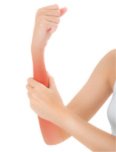
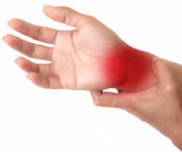
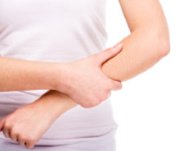
Click the block below that most closely matches your injury for more information and to find the Toolkit we offer to help you in your recovery.




Recent Articles


-
Golfers Elbow Symptoms
Oct 11, 18 05:40 PM
Golfers Elbow (Medial Epicondylitis) symptoms include pain at the medial epicondyle when the fingersw are closed, the wrist bent palmward, or pressure is put on the forearm near the elbow. -
deQuervains Syndrome
Oct 11, 18 05:40 PM
DeQuervains Syndrome is an arthritis-like pain in the thumb, with pain extending through the wrist and forearm when the thumb is moved. Information on symptoms, self care and anatomy. -
Tennis-Elbow-Anatomy
Oct 11, 18 05:40 PM
Tennis Elbow (Lateral Epicondylitis) anatomy is most affected by the extensor muscles and rotator muscles found in the forearm.

Sharon Butler has been a Practitioner of Hellerwork Structural Integration for 34 years and has specialized in helping people recover from Repetitive Strain Injuries of the upper body since 1991. She is the author of the best selling book, “Conquering Carpal Tunnel Syndrome and Other Repetitive Strain Injuries: A Self Care Program” along with 7 comprehensive specialized programs for the Self Care of RSI’s.