Tennis Elbow Symptoms
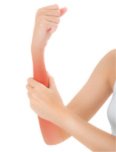
Tennis Elbow (Lateral Epicondylitis) symptoms involve pain when moving the hand, fingers or forearm. Pain is most apparent when bending the wrist or fingers away from the palm, or toward the back of the hand. Twisting the forearm to bring the hand into the palm-up position can also trigger painful symptoms. Pain is usually felt at the point of the lateral epicondyle which is the end of the humerus bone in the upper arm, at the elbow. There is no numbness typically associated with this condition.
A common test that doctors perform to identify Tennis Elbow, or Lateral Epicondylitis, is to have you hold your hand with the palm down, then bend your wrist so your fingers point towards the ceiling. If you experience pain near the elbow when performing this motion, chances are good that you have tennis elbow.
Two of the major muscles that attach to the lateral epicondyle are the Anconeus muscle and the Supinator muscle. These two muscles rotate the forearm to a palm-up position. Chronic contraction of these two muscles puts unusual strain on the tendons of those muscles as they attach to the lateral epicondyle. Irritation is the result and over time could lead to full blown tendonitis known as Tennis Elbow or Lateral Epicondylitis.
Activities that require the twisting of the forearm are known for creating the right conditions for Lateral Epicondylitis to develop. Carrying a tray, an armful of books or even an infant can cause the anconeus and supinator muscles to contract to the point of causing pain. Resting the wrists on a desk or tabletop will cause a contraction or shortening of the extensor muscles in the forearm and can also lead to symptoms.
To learn more about Tennis Elbow (Lateral Epicondylitis), visit the following sections:
Tennis Elbow Anatomy
Tennis Elbow Self Care

Click the block below that most closely matches your injury for more information and to find the Toolkit we offer to help you in your recovery.






Recent Articles


-
Golfers Elbow Symptoms
Oct 11, 18 05:40 PM
Golfers Elbow (Medial Epicondylitis) symptoms include pain at the medial epicondyle when the fingersw are closed, the wrist bent palmward, or pressure is put on the forearm near the elbow. -
deQuervains Syndrome
Oct 11, 18 05:40 PM
DeQuervains Syndrome is an arthritis-like pain in the thumb, with pain extending through the wrist and forearm when the thumb is moved. Information on symptoms, self care and anatomy. -
Tennis-Elbow-Anatomy
Oct 11, 18 05:40 PM
Tennis Elbow (Lateral Epicondylitis) anatomy is most affected by the extensor muscles and rotator muscles found in the forearm.

Sharon Butler has been a Practitioner of Hellerwork Structural Integration for 34 years and has specialized in helping people recover from Repetitive Strain Injuries of the upper body since 1991. She is the author of the best selling book, “Conquering Carpal Tunnel Syndrome and Other Repetitive Strain Injuries: A Self Care Program” along with 7 comprehensive specialized programs for the Self Care of RSI’s.