Thoracic Outlet Syndrome Anatomy
Thoracic Outlet Syndrome anatomy is comprised of many complicated elements involving bone, muscle, connective tissue and nerves. Understanding this anatomy will help reveal the difficulty that exists when trying to create a healing program for this often devastating condition.
Click HERE to Learn More
The Thoracic Outlet Is A Traffic Jam!
The shoulder and neck area is a very complex part of the body, with muscles and connective tissues going in all possible directions. The tissues in the neck tend to have a vertical orientation while the muscles and fascia of the torso tend to be more horizontal. Among all these tissues are muscles and fascia that go from the front to the back, diagonally and obliquely in all possible directions. This is to allow the head and neck their amazing variety of possible movements.
Of course, packed in with all the bones and muscles are the connective tissues. Fascial meridians, tendons, ligaments, filling every possible space and running in every possible direction.
The Brachial Plexus: The Main Nerve Bundle Of The Thoracic Outlet
If there is strain in any part of this region of the body, then the opportunity exists for adhesions to form, trapping and irritating the brachial plexus, the nerve bundle that brings sensation to the arm and hand.
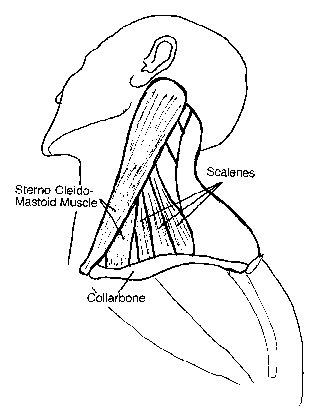
The brachial plexus is the nerve bundle responsible for most of the symptoms of Thoracic Outlet Syndrome.
The brachial plexus branches off of the spinal cord and passes through an opening in the bones at the side of the spine in the neck. It then passes between a powerful group of muscles called the scalenes. It is the job of the scalenes to hold the head up on top of the shoulders and to help turn the head.
As the nerve bundle passes forward from between the scalenes it continues its path by going between the collarbone and first rib and across the front of the shoulder.
As it gets close to the front of the upper arm, the brachial plexus divides into the three main nerves most commonly associated with repetitive strain injuries - the median nerve, the ulnar nerve and the radial nerve. For a condition to be true Thoracic Outlet Syndrome, the entire nerve bundle has to be compromised before the nerve plexus separates into individual nerves.
Alignment of the Cervical Vertebrae
The position of the neck bones is very important in this condition.
If you have ever seen photos of the bones of the neck, they are very irregular in shape with all sorts of nooks and crannies, bony points and openings. It is through these openings that the brachial plexus passes as it leaves the spinal cord. If the position of the bones is shifted or rotated out of alignment, then the opening for the brachial plexus to pass through is potentially narrowed, providing a real opportunity for the entire bundle to become pinched and irritated at the neck.
The Scalene Muscles
The scalene muscles also have an important job. They hold your head up! They are in their best alignment when your head is directly up on top of your shoulders. If your head strays forward, as it does in a slouching posture, then the scalenes, along with other muscles, have to start holding on for dear life because the ten pound weight of your head is pulling your head forward and down off of your shoulders. This forces the scalenes to tighten and shorten. Over time they begin to adhere to one another and then start sticking to neighboring structures as they look for support from the constant strain.
Since the brachial plexus is also passing through this region, the scalenes have the ability to get stuck to the covering of fascia surrounding the nerve plexus. This means that every time you move your head, the fascia of the brachial plexus gets tugged and irritated, causing symptoms of Thoracic Outlet Syndrome. Ouch!
The First Rib
The bottom of the scalenes also attach to the first rib located just behind and below the collarbone. If the scalene muscles become too tight, or out of their normal alignment, they tend to shorten. This causes compression of the neck vertebrae and can also cause the first rib to get pulled upward, narrowing the space available for the brachial plexus to pass between the first rib and the collarbone. Double ouch! This is sometimes referred to as the Double Crush.
The Collarbone
The job of the collarbone is to create the span of the shoulders and also to provide an attachment point for several muscles of the neck and chest. If there is stress in the chest muscles, or in the neck muscles that attach to the collarbone, then adhesions tend to start forming along the collarbone, which may in turn trap or irritate the brachial plexus as it passes through this neighborhood.
You can find additional helpful information in the following sections:
How To Recover From Thoracic Outlet Syndrome
Thoracic Outlet Syndrome Self Care
Thoracic Outlet Syndrome Symptoms
Click the block below that most closely matches your injury for more information and to find the Toolkit we offer to help you in your recovery.







Recent Articles


-
Golfers Elbow Symptoms
Oct 11, 18 05:40 PM
Golfers Elbow (Medial Epicondylitis) symptoms include pain at the medial epicondyle when the fingersw are closed, the wrist bent palmward, or pressure is put on the forearm near the elbow. -
deQuervains Syndrome
Oct 11, 18 05:40 PM
DeQuervains Syndrome is an arthritis-like pain in the thumb, with pain extending through the wrist and forearm when the thumb is moved. Information on symptoms, self care and anatomy. -
Tennis-Elbow-Anatomy
Oct 11, 18 05:40 PM
Tennis Elbow (Lateral Epicondylitis) anatomy is most affected by the extensor muscles and rotator muscles found in the forearm.

Sharon Butler has been a Practitioner of Hellerwork Structural Integration for 34 years and has specialized in helping people recover from Repetitive Strain Injuries of the upper body since 1991. She is the author of the best selling book, “Conquering Carpal Tunnel Syndrome and Other Repetitive Strain Injuries: A Self Care Program” along with 7 comprehensive specialized programs for the Self Care of RSI’s.